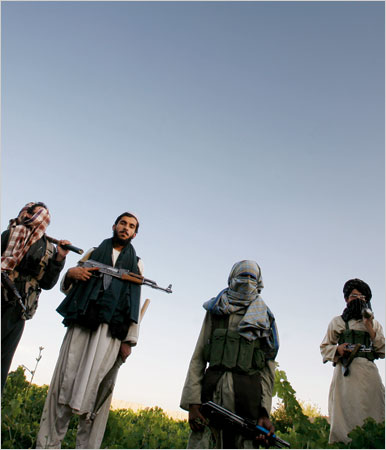
One afternoon this past summer, I shared a picnic of fresh mangos and plums with Abdul Baqi, an Afghan Taliban fighter in his 20’s fresh from the front in Helmand Province in southern Afghanistan. We spent hours on a grassy slope under the tall pines of Murree, a former colonial hill station that is now a popular resort just outside Pakistan’s capital, Islamabad. All around us was a Pakistani rendition of Georges Seurat’s “Sunday on La Grande Jatte” — middle-class families setting up grills for barbecue, a girl and two boys chasing their errant cow with a stick, two men hunting fowl, boys flying a kite. Much of the time, Abdul Baqi was engrossed in the flight pattern of a Himalayan bird. It must have been a welcome distraction. He had just lost five friends fighting British troops and had seen many others killed or wounded by bombs as they sheltered inside a mosque.
He was now looking forward to taking a logic course at a madrasa, or religious school, near Peshawar during his holiday. Pakistan’s religious parties, he told me through an interpreter, would lodge him, as they did other Afghan Taliban fighters, and keep him safe. With us was Abdul Baqi’s mentor, Mullah Sadiq, a diabetic Helmandi who was shuttling between Pakistan and Afghanistan auditing Taliban finances and arranging logistics. He had just dispatched nine fighters to Afghanistan and had taken wounded men to a hospital in Islamabad. “I just tell the border guards that they were wounded in a tribal dispute and need treatment,” he told me.
I went to Afghanistan and Pakistan this summer to understand how and why the Taliban were making a comeback five years after American and Afghan forces drove them from power. What kind of experience would lead Afghans to reject what seemed to be an emerging democratic government? Had we missed something that made Taliban rule appealing? Were they the only opposition the aggrieved could turn to? Or, as many Afghans were saying, was this Pakistan up to its old tricks — cooperating with the Americans and Karzai while conspiring to bring back the Taliban, who had been valued “assets” before 9/11?
And why has the Bush administration’s message remained that Afghanistan is a success, Iraq a challenge? “In Afghanistan, the trajectory is a hopeful and promising one,” Secretary of Defense Donald Rumsfeld wrote on the op-ed page of The Washington Post earlier this month.
Afghanistan’s rise from the ashes of the anti-Taliban war would mean that the Bush administration was prevailing in replacing terror with democracy and human rights.
Meanwhile, a counternarrative was emerging, and it belonged to the Taliban, or the A.C.M., as NATO officers call them — the Anti-Coalition Militia. In Kabul, Kandahar and Pakistan, I found their video discs and tapes in the markets. They invoke a nostalgia for the jihad against the Russians and inspire their viewers to rise up again. One begins with clattering Chinooks disgorging American soldiers into the desert. Then we see the new Afghan government onstage, focusing in on the Northern Alliance warlords — Abdul Rashid Dostum, Burhanuddin Rabbani, Karim Khalili, Muhammad Fahim, Ismail Khan, Abdul Sayyaf. It cuts to American soldiers doing push-ups and pinpointing targets on maps; next it shows bombs the size of bathtubs dropping from planes and missiles emblazoned with “Royal Navy” rocketing through the sky; then it moves to hospital beds and wounded children. Message: America and Britain brought back the warlords and bombed your children. In the next clip, there are metal cages under floodlights and men in orange jumpsuits, bowed and crouching. It cuts back to the wild eyes of John Walker Lindh and shows trucks hauling containers crammed with young Afghan and Pakistani prisoners — Taliban, hundreds of whom would suffocate to death in those containers, supposedly at the command of the warlord and current army chief of staff, General Dostum. Then back to American guards wheeling hunger-striking Guantánamo prisoners on gurneys. Interspliced are older images, a bit fuzzy, of young Afghan men, hands tied behind their backs, heads bowed, hauled off by Communist guards. The message: Foreigners have invaded our lands again; Americans, Russians — no difference.
During the period from 1994 to 2001, the Taliban were a cloistered clique with little interest in global affairs. Today they are far more sophisticated and outward-looking. “The Taliban of the 90’s were concerned with their district or province,” says Waheed Muzhda, a senior aide at the Supreme Court in Kabul, who before the Taliban fell worked in their Foreign Ministry. “Now they have links with other networks. Before, only two Internet connections existed — one was with Mullah Omar’s office and the other at the Foreign Ministry here in Kabul. Now they are connected to the world.” Though this is still very much an Afghan insurgency, fueled by complex local grievances and power struggles, the films sold in the markets of Pakistan and Afghanistan merge the Taliban story with that of the larger struggle of the Muslim umma, the global community of Islam: images of U.S. soldiers in Iraq and Israelis dragging off young Palestinian men and throwing off Palestinian mothers clinging to their sons. Humiliation. Oppression. Followed by the same on Afghan soil: Northern Alliance fighters perching their guns atop the bodies of dead Taliban. In the Taliban story, Special Forces soldiers desecrate the bodies of Taliban fighters by burning them, the Koran is desecrated in Guantánamo toilets, the Prophet Muhammad is desecrated in Danish cartoons and finally an apostate, Abdul Rahman, the Afghan who was arrested earlier this year for converting to Christianity, desecrates Islam and is not only not punished but is released and flown off to Italy.
It is not at all clear that Afghans want the return of a Taliban government. But even sophisticated Kabulis told me that they are fed up with the corruption. And in the Pashtun regions, which make up about half the country, Afghans are fed up with five years of having their homes searched and the young men of their villages rounded up in the name of counterinsurgency. Earlier this month in Kabul, Gen. David Richards, the British commander of NATO’s Afghanistan force, imagined what Afghans are thinking: “They will say, ‘We do not want the Taliban, but then we would rather have that austere and unpleasant life that that might involve than another five years of fighting.”’ He estimated that if NATO didn’t succeed in bringing substantial economic development to Afghanistan soon, some 70 percent of Afghans would shift their loyalty to the Taliban.
Nation-Building, Again
In the middle of Lashkar Gah, the capital of Helmand Province, a metal sign tilts into the road advertising the New York English Language Center. It is a relic of the last American nation-building scheme. Half a century ago, this town, built at the confluence of the Arghandab and Helmand Rivers, was the headquarters for an ambitious dam project partly financed by the United States and contracted out to Morrison-Knudsen, an engineering company that helped build Cape Canaveral and the Golden Gate Bridge.
Lashkar Gah (literally, “the place of soldiers”) was to be a model American town. Irrigation from the project would create farms out of the desert. Today you can still see the suburban-style homes with gardens open to the streets, although the typical Afghan home is a fort with walls guarding the family’s privacy. Those modernizing dreams of America and Afghanistan were eventually defeated by nature, culture and the war to drive the Russians out of Afghanistan in the 1980’s. What remains is an intense nostalgia among the engineers, cooks and farmers of Lashkar Gah, who remember that time as one of employment and peace. Today, Lashkar Gah is home to a NATO base.
Down the road from the base stands a lovely new building erected by an N.G.O. for the local Ministry of Women’s Affairs. It is big, white and, on the day I visited, was empty except for three women getting ready to leave. “It’s so close to the foreigners, and the women are afraid of getting killed by car bombs,” the ministry’s deputy told me. She was a school headmistress and landowner, dressed elegantly in a lime-colored blouse falling below the knees and worn over matching trousers. She weighed the Taliban regime against this new one in terms of pragmatic choices, not terror or ideology. She said that she had just wrapped up the case of a girl who had been kidnapped and raped by Kandahari police officers, something that would not have happened under the Taliban. “Their security was outstanding,” she said.
Under the Taliban, she said, a poppy ban was enforced. “Now the governors tell the people, ‘Just cultivate a little bit,”’ she said. “So people take this opportunity and grow a lot.” The farmers lease land to grow poppies. The British and the police eradicate it. The farmer can’t pay back the landowner. “So instead of paying, he gives the landowner his daughter.”
A few weeks before I arrived in Helmand, John Walters, the director of the White House Office of National Drug Control Policy, told reporters that Afghan authorities were succeeding in reducing opium-poppy cultivation. Yet despite hundreds of millions of dollars being allocated by Congress to stop the trade, a United Nations report in September estimated that this year’s crop was breaking all records — 6,100 metric tons compared with 4,100 last year. When I visited Helmand, schools in Lashkar Gah were closed in part because teachers and students were busy harvesting the crop. A prosecutor from the Crimes Department laughed as he told me that his clerk, driver and bodyguard hadn’t made it to work. They were all harvesting. It requires a lot of workers, and you can earn $12 a day compared with the $2 you get for wheat. Hence the hundreds of young, poor Talibs from Pakistan’s madrasas who had flocked to earn that cash and who made easy converts for the coming jihad.
Walters had singled out Helmand for special praise. Yet just a short drive from the provincial capital, I was surrounded by poppy farmers — 12-year-old boys, 75-year-old men — hard at work, their hands caked in opium paste as they scooped figlike pulp off the bulbs into a sack tied around their waists. One little boy was dragging a long poppy stem attached to a car he had made out of bulbs. Haji Abdul, a 73-year-old Moses of a man, was the owner of the farm and one of those nostalgic for the heyday of the Helmand Valley project. He had worked with Americans for 15 years as a welder and manager. He was the first to bring electricity to his district. Now there was none.
“Why do you think people put mines out for the British and Italians doing eradication when they came here to save us?” He answered his own question: “Thousands of lands ready for harvest were destroyed. How difficult will it be for our people to tolerate that! You are taking the food of my children, cutting my feet and disabling me. With one bullet, I will kill you.” Fortunately he didn’t have to kill anyone. He had paid 2,000 afghanis per jerib (about a half acre) of land to the police, he told me, adding that they would then share the spoils with the district administrator and all the other Interior Ministry officials so that only a small percentage of the poppy would be eradicated.
When I asked Manan Farahi, the director of counterterrorism efforts for Karzai’s government, why the Taliban were so strong in Helmand, he said that Helmandis had, in fact, hated the Taliban because of Mullah Omar’s ban on poppy cultivation. “The elders were happy this government was coming and they could plant again,” Farahi told me. “But then the warlords came back and let their militias roam freely. They were settling old scores — killing people, stealing their opium. And because they belonged to the government, the people couldn’t look to the government for protection. And because they had the ear of the Americans, the people couldn’t look to the Americans. Into this need stepped the Taliban.” And this time the Taliban, far from suppressing the drug trade, agreed to protect it.
A Dealer’s Life
The Continental Guest House in Kandahar, with its lovely gardens, potted geraniums and Internet access in every room, was mostly empty when I arrived, a remnant of the city’s recently stalled economic resurgence.
To find out how the opium trade works and how it’s related to the Taliban’s rise, I spent the afternoon with an Afghan who told me his name was Razzaq. He is a medium-level smuggler in his late 20’s who learned his trade as a refugee in Iran. He was wearing a traditional Kandahari bejeweled skull cap, a dark blazer and a white shalwar kameez, a traditional outfit consisting of loose pants covered by a tunic. He moved and spoke with the confident ease of a well-protected man. “The whole country is in our services,” he told me, “all the way to Turkey.” This wasn’t bravado. From Mazar-i-Sharif, in northern Afghanistan, he brings opium in the form of a gooey paste, packaged in bricks. From Badakhshan in the northeast, he brings crystal — a sugary substance made from heroin. And from Jalalabad, in the east on the road to Peshawar, he brings pure heroin. All of this goes through Baramcha, an unmanned border town in Helmand near Pakistan. Sometimes he pays off the national soldiers to use their vehicles, he said. Sometimes the national policemen. Or he hides it well, and if there is a tough checkpoint, he calls ahead and pays them off. “The soldiers get 2,000 afghanis a month, and I give them 100,000,” he explained with an angelic smile. “So even if I had a human head in my car, they’d let me go.” It’s not hard to see why Razzaq is so successful. He has a certain charm and looks like the modest tailor he once was, not a man steeped in illegal business.
Razzaq’s smuggling career began in Zahedan, a remote and unruly Iranian town near the border with Afghanistan and Pakistan. It is filled with Afghan refugees who, like Razzaq and his family, fled after the Russian invasion in 1979. Razzaq apprenticed as a tailor under his father and eventually opened his own shop, which the Iranians promptly shut down. They said he had no right as a refugee to own a shop. He began painting buildings, but that, too, proved a bureaucratic challenge. He was paid in checks, and the bank refused to cash them without a bank account, which he could not get.
Razzaq was newly married with dreams of a good life for his family. So one day he took a chance. “I had gotten to know smugglers at my tailoring shop,” he told me over a meal of mutton and rice on the floor of my hotel room. “One of them was an old man, so no one ever suspected him. The smugglers asked me to go with him to Gerdi Jangel” — an Afghan refugee town in Pakistan — “and bring back 750 grams of heroin to Zahedan. The security searched us on the bus, but I’d hidden it in the heels of my shoes, and of course they didn’t search the old man. I was so happy when we made it back. I thought I was born for the first time into this world.”
So he took another chance and managed to fly to Tehran carrying four kilos in his bag. Each time he overcame another obstacle, he became more addicted to the easy cash. When the Iranian authorities imported sniffing dogs to catch heroin smugglers, Razzaq and his friends filled hypodermic needles with some heroin dissolved in water and sprayed the liquid on cars at the bus station that would be continuing on to Tehran, Isfahan and Shiraz. “The dogs at the checkpoint went mad. They had to search 50 cars. They decided the dogs were defective and sent them back, and that saved us for a while.” Eventually, he said, they concocted a substance to conceal the heroin smell from the new pack of dogs.
After the fall of the Taliban, Razzaq moved back to Helmand, built a comfortable house and began supporting his extended family with his expanding trafficking business. Razzaq’s main challenge today is Iran. While the Americans have turned more or less a blind eye to the drug-trade spree of their warlord allies, Iran has steadily cranked up its drug war. (Some 3,000 Iranian lawmen have been killed in the last three decades battling traffickers.) To cross the desert borders, Razzaq moves in convoys of 18 S.U.V.’s. Some contain drugs. The rest are loaded with food supplies, antiaircraft guns, rocket launchers, antitank missiles and militiamen, often on loan from the Taliban. The fighters are Baluch from Iran and Afghanistan. The commanders are Afghans.
Razzaq’s run, as he described it, was a scene out of “Mad Max.” Three days were spent dodging and battling Iranian forces in the deserts around the earthquake-stricken city of Bam. Once they made it to Isfahan, however, in central Iran, they were home free. They released the militiamen, transferred the stuff to ordinary cars and drove to Tehran, where other smugglers picked up the drugs and passed them on to ethnic Turks in Tabriz. The Turks would bring them home, and from there they went to the markets of Europe.
Should he ever run into a problem in Afghanistan, he told me, “I simply make a phone call. And my voice is known to ministers, of course. They are in my network. Every network has a big man supporting them in the government.” The Interior Ministry’s director of counternarcotics in Kabul had told me the same thing. Anyway, if the smugglers have problems on the ground, they say, they just pay the Taliban to destroy the enemy commanders.
Razzaq has at times contemplated getting out of the smuggling trade, he said, but the easy money is too alluring. Depending on the market, he can earn from $1,500 to $7,500 a month. Most Afghans can’t make that in a year. Besides, he said, “all the governors are doing this, so why shouldn’t we?”
Losers Become Winners
In December 2001, not long after the Taliban were routed, I visited the Shah Wali Kot district, several hours’ drive on unpaved roads from Kandahar, a Mordor land of rock mountains shaped like sagging crescents and mud-baked houses melting into the dunes. The Taliban leaders had fled, mostly to Pakistan. Gul Agha Shirzai, formerly a local warlord and soon-to-be new governor, and his soldiers had swarmed into power while the Americans set up their operations base in Mullah Omar’s Xanadu-like residence. I was with a large group of Populzai, the clan of the Afghan president, Hamid Karzai.
We were in a big guest room with more than a dozen men gathered in a circle, all wearing the kind of turbans that look like gargantuan ice-cream swirls. The ones in black turban swirls were giggling, chatting and slapping one another on the back. The ones in white turban swirls were sulking, grumbling or mute. In this group, the miserable white turbans were Taliban men. They had just lost their pickup trucks, weapons, money, prestige and jobs, all of which had gone to the gleeful black turbans.
Today those miserable white turbans have taken to the mountains to fight. The gleeful black turbans are under siege. I saw one of the black turbans this summer, the Shah Wali Kot district leader, in the garden of the Kandahar governor’s palace. He was a mess. He chuckled loudly when I asked him how it was back in Shah Wali Kot. “Frankly, we are just defending ourselves from the Taliban,” he said. “Our head is on the pillow at night, but we do not sleep.”
That small division among the Populzai in Shah Wali Kot echoes the larger division of the Pashtun into two main branches: the Durrani and the Ghilzai. The Durrani, Karzai’s tribe, have dominated for the last two centuries in Afghanistan and regard themselves as the ruling elite. In the south, the Ghilzai were often treated as the nomadic, scrappy cousins. With the exception of Mullah Omar, who had been a poor Ghilzai farmer, the leaders of the Taliban tended to be Durrani. These days, the perception among the southern Ghilzai is that they are persecuted, that the jails are filled with their people, while the Durrani in the south received all the Japanese, U.S. and British contracts and jobs. From what I could gather during my weeks in Afghanistan, these perceptions were mostly true. But even if they were exaggerated, such perceptions, in an illiterate society, have a way of quickly morphing into reality.
Take Panjwai, a district just outside Kandahar, where hundreds of Taliban massed this summer, taking advantage of the changeover from American soldiers to a NATO force of Canadian troops. One afternoon I met a red-haired propagandist and writer for the Taliban in a Kandahar office building. With his slight lisp, chain-smoking habit and eclectic reading — French novelists and Arabic philosophers — he seemed more a tormented graduate student than the landless villager from Panjwai he was. Panjwai is a mishmash of tribes, and the Taliban were exploiting the grievances of the Nurzai, a tribe that has felt persecuted and unfairly targeted for poppy eradication. Traders in Kandahar, he said, were donating money to the Taliban. Landowners were paying them to fight off eradicators. The Taliban were paying poor, unemployed men to fight. And religious scholars were delivering the message that it was time for jihad because the Americans were no different from the Russians. Just a few weeks earlier, the Taliban went on a killing spree in Panjwai. They beheaded a tribal leader in his home, shot another in the bazaar and hanged a man near a shrine with a note tacked on his body: “SPY.”
The Taliban were feeling bold enough that one afternoon Mullah Ibrahim, a Taliban intelligence agent, dropped by my hotel for lunch. He was a Ghilzai, from Helmand, and told me he had tried to lead a normal life under the official amnesty program. Instead, he was locked up, beaten and so harassed by Helmandi intelligence and police officers that his tribal elders told him to leave for Pakistan and join the Taliban there. Then, about a year ago, he decided that he was tired of fighting and living as a fugitive and accepted a reconciliation offer from an Afghan general. Pakistani intelligence got wind of this and imprisoned him; upon his release, the Pakistanis gave him money and a motorbike and pressured him to go back to war. He is still tired of war, but the Pakistanis won’t let him live in peace, and now if he tries to reconcile with the Kabul government, he told me, the Taliban will kill him.
When fighting broke out on the main highway near Kandahar, I saw that the police had tied up a group of villagers — but the Taliban had all escaped. One of those village men, his hands bound behind his back, told me that he had peeped out from his house earlier that day and saw some 200 Taliban with new guns and rocket launchers. They wanted food and threatened him and other villagers. “But I am not afraid of them,” he said loudly. “I am only afraid of this government.” Why? “Look at what they do. They can’t get the Taliban, so they arrest us. We have no hope from them anymore. And when we call and tell them Taliban are here, no one comes.” As an engineer from Panjwai who had been an Afghan senator during the Communist era told me: “We are now like camels. In Islam, a camel can be slaughtered in two different ways.
“The Taliban are using rivalries and enmities between people to get soldiers, the same tactics as the mujahedeen used against the Russians,” the engineer continued. “Just like in Russian times they come and say, ‘We are defending the country from the infidels.’ They start asking for food. Then they ask the people for soldiers and say, ‘We will give you weapons.’ And that’s how it starts. And the emotions are rising in the people now. They are saying, ‘Kaffirs have invaded our land.”’
Qayum Karzai, the president’s older brother and a legislator from Kandahar, seemed utterly depressed when I met him. “For the last four years, the Taliban were saying that the Americans will leave here,” he said. “We were stupid and didn’t believe it. Now they think it’s a victory that the Americans left.”
With the Americans on their way out and the NATO force not yet in control, the Kandahar Police were left on the front line: underfinanced, underequipped, untrained — and often stoned. Which is perhaps what made them so brave. One afternoon I ran into a group who said their friends had just been killed when a Talib posing as a policeman served them poisoned tea. A shaggy-haired officer in a black tunic was standing by his pickup, freshly ripped up by a barrage of bullets, and staring at my feet. “I envy your shoes,” he said, looking back at his own torn rubber sandals. “I envy your Toyota,” he said and laughed. And then looking at my pen and notebook, he said, “I envy you can read and write.” It’s not too late, I offered feebly, but he tapped his temple and shook his head. “It doesn’t work anymore,” he said. “I smoke hash. I smoke opium. I’m drinking because we’re always thinking and nervous.” He was 35. He had been fighting for 20 years. Four of his friends had been killed in the fighting the other night. He had to support children, a wife and parents on a salary of about $100 a month. And, he said, “we haven’t been paid in four months.” No wonder, then, that the population complained that the police were all thieves.
At Kandahar’s hospital I met a 17-year-old policeman (who had been with the police since he was 14) tending to his wounded friend. He was in a jovial mood, amazed he wasn’t dead. He said they had been given an order to cut the Taliban’s escape route. Instead they were ambushed by the Taliban, ran out of bullets and had no phones to call for backup. “We ran away,” he said with a nervous giggle. “The Taliban chased us, shouting: ‘Hey, sons of Bush! Where are you going? We want to kill you.”’
Last month, NATO forces struck back around Panjwai with artillery and aerial bombardments, killing an estimated 500 Taliban fighters and destroying homes and schools. But unless NATO can stay for years, create a trustworthy police force and spend the millions necessary to regenerate the district, the Taliban will be back.
Deciding to Fight
Inside the old city walls of Peshawar, Pakistan, a half-hour drive from the Afghan border, in a bazaar named after the storytellers who enthralled Central Asian gold and silk merchants with their tales of war and tragic love, sits the 17th-century Mohabat Khan Mosque. It is a place of cool, marble calm amid the dense market streets. Yousaf Qureshi is the prayer leader there and director of the Jamia Ashrafia, a Deobandi madrasa. He had recently announced a pledge by the jewelers’ association to pay $1 million to anyone who would kill a Danish cartoonist who caricatured the Prophet Muhammad. Qureshi himself offered $25,000 and a car. I found Qureshi seated on a cushion behind a low glass desk covered with papers and business cards — ambassadors, N.G.O. workers, Islamic scholars, mujahedeen commanders: he has conversed with them all. His office resembles an antiques shop, the walls displaying oversize prayer beads, knives inlaid with ivory and astrakhan caps. It was day’s end, and Qureshi was checking the proofs for his 51st book, called “The Benefits of Koran.”
Qureshi told me that he meets with Pakistan’s president, Pervez Musharraf, about twice a year. Qureshi understands Musharraf’s predicament: “The heart of this government is with the Taliban. The tongue is not.” He didn’t claim total insider knowledge, but he said, “I think they want a weak government and want to support the Taliban without letting them win.” Why? “We are asking Musharraf, ‘What are you doing,’ and he says: ‘I’m moving in both ways. I want to support the Taliban, but I can’t afford to displease America. I am caught between the devil and the deep sea.”’
Not long ago, Qureshi said, he received three emissaries from Mullah Omar who wanted Qureshi to warn another religious leader to stop preaching against the Taliban. “I refused,” he said. Later Sheikh Yassin, one of the messengers, was arrested by the I.S.I., Pakistan’s military intelligence service. So why, I asked, does Qureshi say the I.S.I. is supporting the Taliban? “That is the double policy of the government,” he replied. Even in the 1990’s, he said, Prime Minister Nawaz Sharif was supporting the official Afghan government of Burhanuddin Rabbani while the I.S.I. was supporting his opponent, Gulbuddin Hekmatyar, as he rained thousands of rockets upon Rabbani’s government and the citizens of Kabul. Qureshi told me that if he and local traders didn’t want Al Qaeda or the Taliban to flourish, then they wouldn’t. “We are supporting them to give the Americans a tough time,” he said. “Leave Afghanistan, and the Taliban and foreign fighters will not give Karzai problems. All the administrators of madrasas know what our students are doing, but we won’t tell them not to fight in Afghanistan.”
The new Taliban fighters in Afghanistan are of three basic types. There are the old war-addicted jihadis who were left out of the 2001 Bonn conference, which determined the postwar shape of Afghan politics and the carve-up of the country. There are the “second generation” Afghan refugees: poor, educated in Pakistan’s madrasas and easily recruited by their elders. And then there are the young men who had jobs and prestige in the former Taliban regime and were unable to find a place for themselves in the new Afghanistan.
Coincidentally, there are also now three fronts. One is led by Mullah Omar’s council in Quetta. The second is led by Jalaluddin Haqqani, a hero of the jihad against the Soviets who joined the Taliban. Although well into his 80’s, he orchestrates insurgent attacks through his sons in Paktia, Khost and Paktika, the Afghan provinces close to Waziristan, where he is based. Finally, there is Gulbuddin Hekmatyar, the former leader of Hezb-i-Islami, the anti-Soviet fighters entrusted with the most money and arms by the U.S. and Pakistan. He had opposed the Taliban, living in uneasy exile in Iran until the U.S. persuaded Tehran to boot him out; he sneaked into the mountainous eastern borderlands. Since the early days of Karzai’s government, he has promised to organize Mullah Omar’s followers with his educated cadres and finance their jihad against Karzai and the American invaders. Old competitors are coming together in much the way the mujahedeen factions cooperated to fight the Russians. Hekmatyar adds a lethal ingredient to this stew: his ties and his followers extend all through Afghanistan, including the north and the west, where he is exploiting factional grievances that have nothing to do with the Pashtun discontent in the south.
An Afghan I met outside Peshawar — for his safety he asked me not to use his full name — was typical of the 20-something Talibs who had flourished under the Taliban regime. He was from Day Chopan, a mountainous region in Zabul Province, northeast of Kandahar. When the Northern Alliance and the Americans took Afghanistan, he escaped through the hills on an old smuggling route to the North-West Frontier Province.
It was familiar terrain. A.’s father had been a religious teacher who studied in Sami ul-Haq’s famous Haqqaniya madrasa near the Khyber Pass and preached jihad for Harakat, one of the southern mujahedeen parties whose members filled Mullah Omar’s ranks. Those old ties still bind and have provided a network for recruiting. A. grew up in madrasas in the tribal Pashtun lands of Waziristan, where he learned to fire guns as a child in the American-financed mujahedeen camps. As a teenage religious student in Wana, the capital of South Waziristan, he would go door to door collecting bread for his fellow Talibs. Behind one of those doors, he saw a girl and fell in love. When his father wouldn’t let him marry the girl, he threatened to go fight in Afghanistan. His father would not relent, and A. signed up at the local Taliban office in Peshawar. “We got good food, free service, everything was Islamic,” he told me. “It was the best life, rather than staying in that poor madrasa.” His father soon did relent, and A. became engaged, but he was only 15 and had no money. So he went back to the Taliban and was soon working beside the deputy defense minister. “Of course, then there were bags of money,” he said.
A., now 28, was living in an Afghan refugee village that used to belong to Hekmatyar’s group. Weak with malaria, he was nevertheless plump and jovial, even funny at times. Only when the Pakistani intelligence services came up did his already sallow hues pale to old bone.
After fleeing the American bombardment in 2001, he told me, the Taliban arrived in Pakistan tattered, dispersed and demoralized. But in the months after the collapse, senior Taliban leaders told their comrades to stay at home, keep in touch and wait for the call. Some Taliban told me that they actually waited to see if there was a chance to work with Karzai’s government.
“Our emir,” as A. referred to Mullah Omar, slowly contacted the commanders and told them to find out who was dead and who was alive. Those commanders appointed group commanders to collect the underlings like A. Weapons stashed away in Afghanistan’s mountains were excavated. Funds were raised through the wide and varied Islamic network — Karachi businessmen, Peshawar goldsmiths, Saudi oil men, Kuwaiti traders and jihadi sympathizers within the Pakistani military and intelligence ranks.
Mullah Omar named a 10-man leadership council, A. explained. Smaller councils were created for every province and district. Most of this was done from the safety of Pakistan, and in 2003 Mullah Omar dispatched Mullah Dadullah to the madrasas of Baluchistan and Karachi to gather the dispersed Talibs and find fresh recruits. Pakistani authorities were reportedly seen with him. Still, neither Musharraf nor his military men in Baluchistan did anything to arrest him.
It was a perfect job for Dadullah, whose reputation for bravery was matched by his savagery and his many war wounds, collected in more than 25 years of fighting. In 1998, his fighters slaughtered hundreds of Hazaras (Shiites of Mongol descent) in Bamiyan Province, an act so brutal it was even too much for Mullah Omar, who had him disarmed at the time. Dadullah’s very savagery, filmed and now often circulated on videotape, coupled with his promotional flair, were just the ingredients Omar needed to put the Taliban back on the map.
Today, Quetta has assumed the character of Peshawar in the 1980’s, a suspicious place of spies and counterspies and double agents. It is not just the hundreds of men in typical Afghan Pashtun clothing — the roughly wound turbans, dark shalwar kameez, eyes inked with kohl — who squat on Thursday afternoons outside the Kandahari mosque in the center of town, comparing notes on the latest fighting in Helmand or the best religious teachers. Rather, as I wandered the narrow alleyways of the Afghan neighborhoods, my local guides would say, “That’s where Mullah Dadullah was living” or “That’s where Mullah Amir Khan Haqqani is living.” (Haqqani is the Taliban’s governor in exile for Zabul Province.) Mullah Dadullah is now a folk hero for young Talibs like A. And all the Taliban I met told me that every time Dadullah gives another interview or appears on the battlefield, it serves as an instant injection of inspiration.
By 2004, A. said, he was meeting a lot of Arabs — Saudis, Iraqis, Palestinians — who taught the Afghans about I.E.D.’s (improvised explosive devices) and suicide bombings. “They taught us how to put explosives in plastic,” he told me. “They taught us wiring and triggers. The Arabs are the best instructors in that.” But now the Afghans are doing fine on their own. Pakistani jihadis in Afghanistan received their training, they told me, from Pakistani officers in Kashmir.
The southerners have also forged ties with the Pakistani Taliban in Waziristan. There is a free flow of arms and men between Waziristan and the Afghan provinces across the border. According to A., even Uzbeks from the Islamic Movement of Uzbekistan have joined some of the fighters now in A.’s home mountains in Day Chopan.
It was disheartening to hear A. describe his first encounter with Americans, who were trying to set up a base in a remote region of Zabul. Though they were building a road where no roads had gone before, he could perceive that asphalt only as a means for the Americans to transport their armored vehicles and occupy Muslim lands. A friend of his joined us as we were talking. He had just arrived in Pakistan from the Day Chopan region and said that the Americans were like a cyclone of evil, stealing their almonds and violating their Pashtunwali (the Pashtun tribal laws). In this instance, he meant the law by which even a cousin will not enter your house without knocking first.
A. is now a media man in Pakistan, coordinating the editing of films for discs, censoring them in case there are commanders who don’t want their faces seen and distributing them. He proudly offered me the latest disc of Mullah Dadullah beheading some “spies for the Americans.” He said he had sold 25,000 CD’s about the fighting in Waziristan.
He was full of contradictions. He said that if he didn’t have a house in Day Chopan, he would never spend a single night there because there was no education, no electricity, no power, nothing, just a heap of stones. Yet he did not want America to change all that. “We don’t like progress by Americans,” he declared. “We don’t like roads by Americans. We would rather walk on tired feet as long as we are walking in an Islamic state.”
Was it all just bravado speaking? Was an opportunity to build bridges to young men like A. somehow lost or just neglected? It was hard to tell. But when the I.S.I. subject came up again, his tone changed. “They are snakes,” he told me. He said that they were trying to create a new, obedient leader and oust the independent-minded Mullah Omar, and for that, the real Taliban hated them. Then he said: “I told you that we burn schools because they’re teaching Christianity, but actually most of the Taliban don’t like this burning of schools or destroying roads and bridges, because the Taliban, too, could use them. Those acts were being done under I.S.I. orders. They don’t want progress in Afghanistan.” An Indian engineer was beheaded in Zabul in April, he said, and that was also ordered by Pakistan, which, from fear of the influence of its enemy, India, was encouraging attacks on Indian companies. “People are not telling the story, because no one can trust anyone, and if I.S.I. knows I told you,” he said, he would be dead.
Pakistan’s Assets
There are many theories for why Pakistan might have wanted to help the Taliban reconstitute themselves. Afghan-Pakistani relations have always been fraught. One among the many disputes has to do with the Durand Line, the boundary drawn up by the British in 1893 partly to divide the Pashtun tribes, who were constantly revolting against the British. The Afghan government has never recognized this line, which winds its way from the Hindu Kush mountains of North-West Frontier Province 1,500 miles down to the deserts of Baluchistan, as its border. Nor have the Pashtun tribes. The Pakistanis may hope to force Karzai to recognize the Durand line in exchange for stability.
Another theory is that Musharraf must appease the religious parties whom he needs to extend his power past the end of his term next year. Musharraf bought them off, gave them control of the North-West Frontier Province and Baluchistan and let them use the Taliban. And finally, the Pakistanis see Afghanistan as their rightful client. They want an accommodating regime, not Karzai, whose main backers are the U.S. and India, Pakistan’s nemesis.
Pakistan’s well-established secular Pashtun nationalist political leaders remain distraught that their lands have again become sanctuaries for the Afghan Taliban and the Pakistani religious parties, which, since elections in 2002, rule these provinces and are completing a Talibanization of the region. The secular leaders point to another layer in Pakistan’s games: keeping the tribal areas autonomous enables Pakistan’s intelligence services to ward off the gaze of Westerners and keep their jihadis safely tucked away.
One thing you notice if you visit the homes of retired generals in Pakistan is that they live in a lavish fashion typical of South America’s dictatorship-era military elite. They control most of the country’s economy and real estate, and like President Musharraf, himself a former general, they do not want to relinquish power.
Although there is a secularist strain in the Pakistani military, it has been aligned with religious hard-liners since the army’s inception in 1947. Many officers still see their duty as defending the Muslim world, but their raison d’être has been undermined by the fact that though Pakistan was founded as a refuge for South Asia’s Muslims, more Muslims today live in India. They seem to envy the jihadis’ clarity. The militants had no identity crises. According to Najim Sethi, a prominent Pakistani journalist, military officers often have “a degree of self-disgust for selling themselves” to the Americans, and they still bear a grudge against the United States for abandoning them after the Afghan jihad and, more recently, for sanctioning Pakistan over its nuclear program. The standard army phrase about the Americans was, he said, “They used us like a condom.”
Officers spoke to me as if they were simply translating the feelings of the jihadis for a tone-deaf audience, but they sounded more like ventriloquists. One retired colonel I spoke to was a relative of a Taliban leader from Waziristan, Abdullah Massoud, who had earned both sympathy and reverence for his time in Guantánamo Bay. Massoud was captured fighting the Americans and the Northern Alliance and spent two years there, claiming to be a simple Afghan Talib. Upon his release, he made it home to Waziristan and resumed his war against the U.S. With his long hair, his prosthetic limb and impassioned speeches, he quickly became a charismatic inspiration to Waziristan’s youth.
Since 2001, some of Waziristan’s tribes have refused to hand over Qaeda members living among them. Under intense American pressure, Pakistan agreed for the first time in its history to invade the tribal areas. Hundreds of civilians and soldiers were killed. American helicopters were seen in the region, as were American spies. The militants (with some army accomplices) retaliated with two assassination attempts against Musharraf late in 2003. He struck back, but as the civilian casualties mounted and the military began to balk at killing Pakistanis, Musharraf agreed to a deal in the spring of 2004 whereby the militants would give up their guests in return for cash. Pakistani officers and the militants hugged and shed tears during a public reconciliation. But the militants did not relinquish their Al Qaeda guests, and they took advantage of the amnesty to execute tribal elders they said had helped the Pakistani military. The tribal structure in Waziristan was devastated, and the Taliban took to the streets to declare the Islamic emirate of Waziristan. Since Musharraf signed a truce with the militants last month, attacks launched from Waziristan into Afghanistan, according to NATO, have risen by 300 percent.
“Muslim governments are not able to face the Americans,” the retired colonel from Waziristan said, explaining the mujahedeen mind-set. “If Muslim governments should stand up against duplicity and foreign hegemonic designs, and they don’t, who will? Someone has to stand up to defend the Muslim countries, and it’s this that gives the jihadis the courage and zeal to stand up to the worst atrocities. This is the core issue of the mujahedeen movement. You call it the war on terror. The mujahedeen call it jihad.” And so, essentially, did he.
One afternoon, in the midst of a monsoon, I sought out one of the founders of the pro-jihadi strategy, the retired general Mirza Aslam Beg. He lived in Rawalpindi, the military capital half an hour from Islamabad, in a brick and tile-roofed mansion with a basketball hoop, flowing greenery and Judy, his one-eyed cocker spaniel. The house was immaculate, with marble floors, rugs, fine china and porcelain on display behind glass and an amusing portrait of Aslam Beg as a young, Ray-Banned, pommaded officer. His mansion sits across the street from Musharraf’s.
Aslam Beg played a leading role in the military’s creation of “asymmetrical assets,” jargon for the jihadis who have long been used by the military as proxies in Kashmir and Afghanistan. He was chief of the army staff from 1988 to 1991, while the Pakistani nuclear scientist A.Q. Khan was selling the country’s nuclear technology to Iran, Libya and North Korea. Beg held talks with the Iranians about exchanging Iranian oil for Pakistani nuclear skill.
Aslam Beg likes to remind visitors that he was one of a group of army officers trained by the C.I.A. in the 1950’s as a “stay-behind organization” that would melt into the population if ever the Soviet Union overran Pakistan. Those brigadiers and lieutenant colonels then trained and directed the Afghan jihadis.
In the 1980’s, “the C.I.A. set up the largest support and administrative bases in Mohmand agency, Waziristan and Baluchistan,” Aslam Beg told me. “These were the logistics bases for eight long years, and you can imagine the relations that developed. And then Chechens, Uzbeks, Tajiks, Saudis developed family relations with the local people.” The Taliban, he said, fell back after 2001 to these baselines. “In 2003, when the U.S. attacked Iraq, a whole new dimension was added to the conflict. The foreign mujahedeen who’d fought in Afghanistan started moving back to Afghanistan and Iraq.” And the old Afghan jihadi leaders stopped by the mansion of their mentor, Aslam Beg, to tell him they were planning to wage war against the American occupiers.
As the rain outside turned to hail, banging against the windows, Aslam Beg ate some English sandwiches that had been wheeled in by a servant. “As a believer,” he went on, “I’ll tell you how I understand it. In the Holy Book there’s an injunction that the believer must reach out to defend the tyrannized. The words of God are, ‘What restrains you from fighting for those helpless men, women and children who due to their weakness are being brutalized and are calling you to free them from atrocities being perpetuated on them.’ This is a direct message, and it may not impact the hearts and minds of all believers. Maybe one in 10,000 will leave their home and go to the conflicts where Muslims are engaged in liberation movements, such as Chechnya, Palestine, Iraq, Afghanistan and Kashmir. Now it’s a global deterrent force.”
The Authentic Jihad
The old city of Lahore, with its broad boulevards and banyan-tree canopies, remains the cultural and intellectual heart of Pakistan. It is home to a small elite of journalists, editors, authors, painters, artists and businessmen. Najam Sethi, editor in chief of The Friday Times, and his wife, Jugnu Mohsin, the publisher, are popular fixtures among this crowd. Like so many of Pakistan’s intellectuals, they have had their share of run-ins with government security agents. For pushing the bounds of press freedom, Sethi was dragged from his bedroom during Nawaz Sharif’s reign, beaten, gagged and detained without charge. Musharraf, in his new autobiography, claims that Nawaz Sharif wanted him to court-martial Sethi for treason, an act that seemed ludicrous to him, and he refused.
I met him one afternoon at the newspaper’s offices as he was preparing his weekly editorial. He is a tall, affable man with smiling eyes and large glasses. And he got right down to business, providing an analysis of why Pakistan had decided to bring its “assets” — by which he meant the Taliban and Kashmiri jihadis — off the shelf.
In the days following 9/11, when Musharraf gathered together major editors to tell them that he had no choice but to withdraw his support for the Taliban, Sethi raised the touchy issue of the other jihadis. He said that if Musharraf was abandoning the Taliban, he would have to abandon the sectarian jihadis (fighting the Shiites), the Kashmir jihadis, all of the jihadis, because they were all trained in mind by the same religious leaders and in body by the same Pakistani forces.
In January 2002, Musharraf gave an unusually long televised speech to the nation. He reminded the people that his campaign against extremism was initiated years before and not under American pressure. He vowed that Pakistan would no longer export jihadis to Kashmir, that he was again placing a ban on several jihadi organizations, that camps would be closed and that while the madrasas were mostly educating the poor, some were centers of extremist teaching and would be reformed. A month later, Musharraf was at the White House next to President Bush, who praised him for standing against terrorism.
Sethi characterized Pakistani authorities as believing that the U.S. in Iraq “will be a Vietnam.” He said: “Afghanistan will be neither here nor there. So we cannot wrap up our assets. We must protect them.” The I.S.I. realized it could help deliver Al Qaeda to the U.S. while keeping the Taliban and the jihadis on the back burner. At the same time, Musharraf’s moderate advisers were telling him that holding on to those assets would eventually boomerang. And soon enough, the assets began to come after Musharraf — while the people of Pakistan were turning against him for being pro-American. “So going after jihadis who were protecting the Taliban came to a halt,” Sethi said.
Meanwhile the landscape next door in Afghanistan was changing. The warlords were back in action. The drug economy was surging. By 2003 and 2004, Musharraf’s men were becoming hysterical about what they saw as a growing Indian presence in Afghanistan, particularly the Indian consulates in Kandahar and Jalalabad, the Pashtun strongholds that Pakistan considered its own turf. Karzai was doing business with Indians and Americans and was no longer a Pashtun whom Pakistanis would want to do business with.
As Sethi spoke, I recalled a meeting I had with one of Kandahar’s prominent tribal leaders. He recounted a visit from a former Pakistani general who had been active in the I.S.I. The general invited Kandahar’s leaders to lunch and warned them not to let the Indians put a consulate in Kandahar and to remember who their real benefactors were. Today there is a consulate there, and Indian films and music are sweeping through the Pashtun lands. What is more, many Pakistanis believe India is backing the Baluch insurgency in Pakistan’s far south, clouding the prospects for the new, Chinese-built port in Gwadar. The port is Pakistan’s single largest investment in its economic future and has been attacked by Baluch rebels.
In many ways, Pakistani policy is already looking beyond both Karzai and the Americans; they believe it is prudent to imagine a future with neither. That future will be shaped by the past: the past with India, the past with the Soviet Union, the past with America. For Pakistan’s hard-liners, at least, the obvious choice was to take their assets off the shelf and restart the jihad.
A Difficult Choice
On the wall outside the Eid Ga madrasa, in Kuchlak, a parched town near Quetta, Afghan students and teachers were debating the merits of jihad. One boy had just fled an American assault on Day Chopan in Zabul Province. He had never been to Pakistan before. He was frenzied, in shock. As a student from Kandahar led the others in dusk prayer, a young boy whispered to me, “I like America.” They were hardly a unified group. One young Helmandi told me, “We want our traditions of Islam and Sharia, not your democracy,” while another argued for peace. Then the Helmandi asked, with genuine confusion: “Why are Muslims being tortured everywhere in the world, and no one is there to stand up for them? But if you touch one Westerner, the sky is on your head?”
Most madrasas in Pakistan are run by the Jamiat Ulema-e-Islam, the religious-party alliance that has joined with Musharraf to keep the popular parties of Benazir Bhutto and Nawaz Sharif from regaining power. The J.U.I. madrasas usually endorse jihad, although even here I met madrasa students who were against the war. They subscribed to a vision of jihad as a struggle for self-improvement and the improvement of society. Mawlawi Mohammadin, a cleric from Helmand, went so far as to tell me that these are the true roots of jihad, though he confessed that his is a lonely voice. He was afraid of everyone — Taliban, Pakistani intelligence, even his pupils. “If we start openly supporting Karzai, we could be killed by our own students,” he told me with nervous laughter. Only a month earlier, a Taliban official from Helmand who had reconciled with Karzai’s government was gunned down by assassins on a motorbike in Quetta.
Mohammadin said that it is now open season for jihad in Afghanistan under J.U.I. guidance. Government ministers were even attending funerals to praise Pakistani Pashtuns who had died fighting in Kandahar. He estimates that there are some 10,000 Taliban fighters in Baluchistan. Despite the intimidation, he says he feels that his mission is to steer his students away from war.
One of these was Mohamed Nader, who had just attended a cousin’s funeral and was wondering what it all meant. His cousin’s family was poor, and without their knowledge, he had gone to earn money first by harvesting poppies in Helmand and then by fighting for the Taliban. Finally he was killed. Among the biggest problems, Nader told me, was that the cohesion of the Afghan family has been shredded by decades of poverty and refugee life in Pakistan. In a typically strong Afghan family, young adults obey their parents, even asking for permission to go fight. But here, boys just run off.
Rahmatullah was one of those who had run off and returned. He was skinny and disheveled, having just faced heavy fighting in Kandahar. Though an Afghan, he had grown up in Baluchistan, near the border, in an area where he said 200 fighters were now living. The mullah at his madrasa told all the students that it was time for jihad. And the I.S.I. was paying cash. But his father was old and against the war; he pleaded with him to abandon fighting. So he sent Rahmatullah to his friend Mohammadin, hoping he might open another path for his son. Rahmatullah told me that he wasn’t sure yet which mullah he would listen to.
(Next week, Part 2: How U.S. and NATO forces have been battling the Taliban and fighting for hearts and minds.)
Read full post and comments:
"In the Land of the Taliban" >>